





快问快答0:00
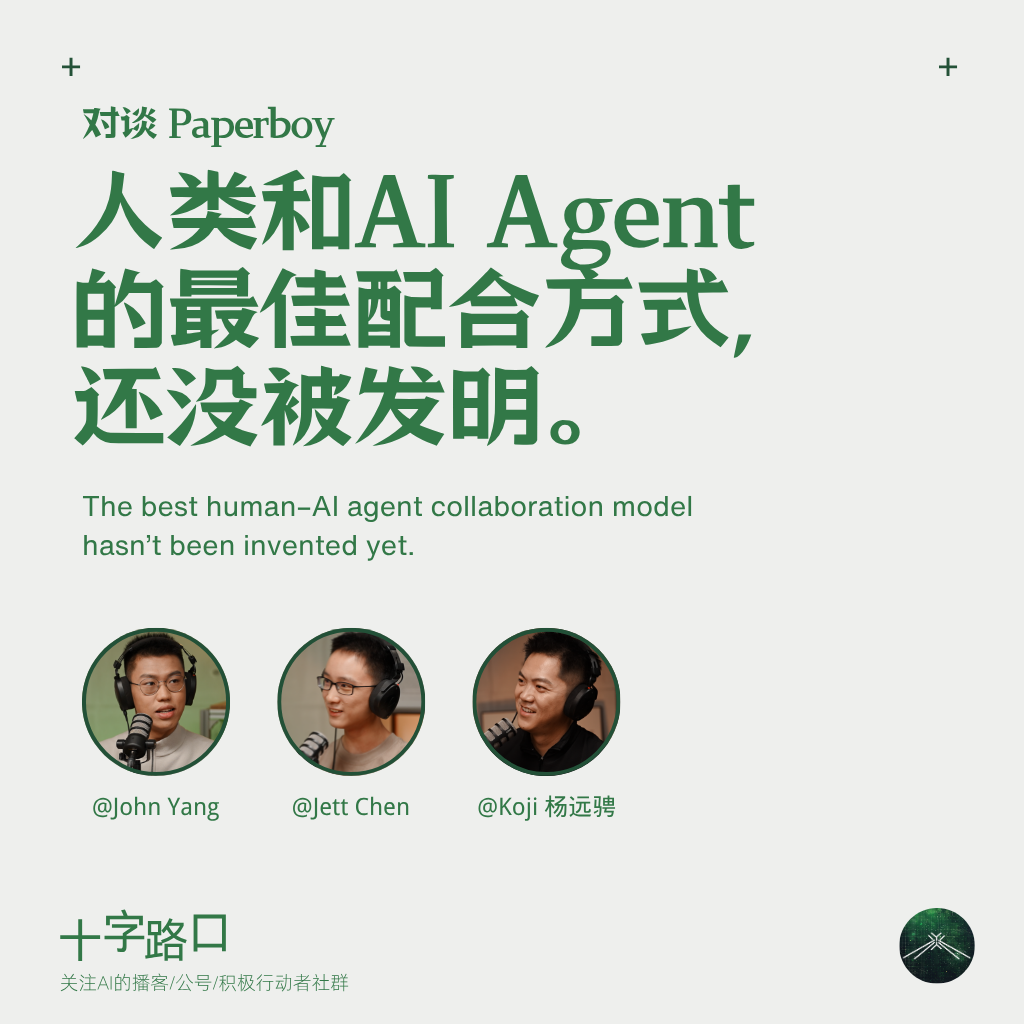
嗨 , 我是 Koji, 那本周十字路口呢我们请到的嘉宾是 Paperboy 的创始人 John Yang,以及他们的一位 founding engineer Jett Chen。 呃 , 你好二位 , 欢迎来到 《 十字路口 》。
Hello, Koji.
哈喽哈喽 。 在这里也给大家说明一下 ,因为 John 用英文表达会比较自然 , 所以我们这一期内容会比较中英夹杂 。
我们同时有音频和视频 , 如果大家这个需要的话可以去看视频 。 看视频的我们就会配字幕和字幕的翻译 , 帮助大家理解 。
我们还是从十字路口的传统快问快答开始哈 ,有请二位的年龄 。
Oh, I'm 21.
19。
你们的毕业院校 ?
My BA, uh, Pratt Institute, I studied architecture.
呃 , 我是上海星环双语学校高中毕业 , 然后现在在 CMU 读大一 , 大一刚结束 。
你们的 MBTI 和星座是什么 ?
Uh, ISTJ, Cancer.
INTJ, 处女座 。
创业之前你们做了一些什么 ?
Paperboy 是我第二家公司 , 我的一家公司叫 Million, 呃 , 我们是在 React ecosystem 里做了很多开源的 DevTools, 然后我们做了一个产品叫 SameDot Dev。
普通人可以用一句话去输入一个 URL, 然后做出和任何网站一模一样的一个 UI。 And, uh, Million was in YC, when I'm 24.
我在 Paperboy 之前是个高中生 。 我比较喜欢做开源项目 , 然后我喜欢打 CTF。 我做了一个东西叫 EarthKit, 你拍一个照片 , 然后我用这个多模态去推测这个照片在哪里拍出来的 , 会比就传统的纯神经网络的模型会更好 。
那是哪一年 ?
差不多一两年前 。
那我们来介绍一下这个 ,Paperboy 是一个什么样的产品 ?
Paperboy as a company just started broadly with the mission of, I am trying to figure out 我最喜欢的 , 嗯 , 和 AI 一起合作的方式 。 我对去年, 呃 , 你知道做了 Same 以后 ,在 Manus 以后, 呃 , 用过的产品都有那么一些不爽 。
起点1:59
So yeah, Paperboy just started with me trying to hack around, um, different approaches to try to figure out how to, uh, solve, um, there are technical problems here, um, but also form factor, like 我不应该需要把自己的文件 , 还有 email, 还有 all this personal information 丢到一个聊天框里 。
我如果需要和别人一起合作 , 同时跟一个 agent 对话 this should be a very easy way for me to, for us to collaborate, um, within the same, um, context window. Agent 如果知道了我的很多信息以后 ,他应该可以 , 呃 ,proactive 的提前去帮我做一些事情 。
嗯 ,但是现在的 Chat Window 中 you really can't do it. 嗯 , 然后还有就是现在所有产品 , 呃 , 都是 sessions based, 所以 session 一落你就找不到过去你要从哪个 context window 继续聊下去了 。
So just all kinds of these problems, I think, where generally speaking it's the gap between model capabilities and deployment. And, uh, I feel like there was still a large opportunity to, to explore and innovate, uh, on the product experience.
Um, and hence the name is Paperboy Products.
我们待会会展开一下 ,但我们先把快问快答做完 。 呃 , 你们的融资情况是什么 ?
Uh, we raised 4.7 million at 25.
哦 ,cool。 呃 , 收入和利润呢 ? 现在还没有发布对吧 ?
Uh, zero and negative gross margins, and we lose money every day.
你们估计什么时候会发布产品大家用到 ?
So we shipped a prototype to friends, and that's like our, uh, agent that learns from OS activities. But, uh, there are cost issues, it's too expensive, it doesn't really work. Um, so the next iteration of this product, we're trying to wrap it up by this month.
And, um, it's gonna try, we're gonna try to go to market again and.
我们发播客的时候会放一个这个链接 ,在下面大家感兴趣可以去这个 sign up 一下 。
Oh yeah, you guys will see it, I think, when this podcast come out for sure.
好 , 然后咱们目前团队规模呢 ?
现在有 12 个全职 , 呃 , 员工 , 然后是 10 位 engineer。
我记得第一次见到 John 的时候你给我看了一个文档 , 那个文档应该是你写出来给内部去开会的时候用的一个会议文档 。
当时第一句话就是你说 " 人类和 AI 配合工作的最佳的方式 , 很可能还没有被发明出来 。" 写这句话的时候你看到了什么 , 然后到今天你觉得你看到的事情有发生一些变化吗 ?
最佳方式4:27
Yeah, so that doc is, uh, the one I prepared for our very first all-hands. 呃 , 那个时候公司就我 , 杜哥 , 陈 ,Jett, 四位 。 And 11 月 30 号 . And yeah, I think we just started working with one thesis, which is the best way to work with AI hasn't been invented.
And we have a shot at, um, being the team that figures out that way. So Cursor started really trying to figure out what's the best way to code with AI. And, um, they have been largely successful being sort of, I think, the first company to really approach on that goal.
Um, and they figured out, um, how important it was to, you know, focus on that goalpost before everybody else. 你问我那个从这句话说到现在还有什么新的学习 , I think what's cool is Jett's issue should be a moving goalpost.
Uh, instead of market's expectation, you can't really reach it, you can only keep getting better. Um, because every time you come up with something new,right, everybody else see it, and if the other teams have taste, um, if the users have taste, um, they will know, um, and they will see the friction points.
There will always be frictions. Um, and so all you have to do is just keep getting better. So I think it's really a moving goalpost. And we're from Senzai, you know, OpenClaw came out, we have Claude Cowork, which is Anthropic's, you know.
对 , 所以其实最近很多 founder 感到有一点绝望 , 就因为在这个创业的过程中不断有新的王炸出现 。
对啊 , 正好其实你们在这个从创立公司到现在这半年, 又是变化非常剧烈的半年 。 嗯哼 。 啊 , 从 Claude Code 到 OpenClaw, 然后再到 Erms。
所以你的感受是什么 ? 就是你一开始想象的要做的东西和今天在做的东西 ,有因为不断的这些新的庞然大物的出现而发生剧烈的变化吗 ?
还真没有什么剧烈的变化 。 因为 I think the problem space comes from people. How I think about this problem space from a technical, from a product point of view is three categories of problems.
You have the technology of agents being able to actually learn from the user's environment. Uh, it has to be integrated into where the user already works, where the data comes from, lots of files on a computer and integrations.
And then the second thing is you have to be personalized. So personalization means you don't really have to prompt it as much. You can trust it to work on, you know, more and more complex and difficult things. You can trust it to make more higher stakes decisions.
And it also means being more reliable. Um, and that means, you know, you can actually use the model and just keep running it for longer and longer periods. And also, uh, from a design point of view, it needs to be extremely intuitive to use.
You shouldn't have to learn it as like a new tool. If your agents are proactive, they can bring up new ideas by themselves. What is the form that holds all of these proactive outputs together? It has to be within the environment and it needs to be personalized.
It needs to be able to collaborate well with your existing team. So when you look at, um, new tools that's come out, there's not really a new dimension that's come out yet, because these three dimensions are limited by the human teams.
我们要不要非常简单的安利一下大家 , 就是为什么要用 Paperboy? 因为听我们播客的很多人可能已经是重度的 Cloud Code 或者 Manus 或者这个什么 agent 的用户 。
对吧 , 为什么要在这个时候给 Paperboy 一次机会来用你们 ?
Yeah, so, uh, 现在 Cloud Code and Manus, to me, they're kind of the most successful forms of agents out there. They are session-based, and there are one-to-one, like, prompt-based. So these are two very important, um, factors here.
Session之困8:01
Session-based means in their sidebar there is a bunch of, you know, you have workspaces which are projects, and then per project you have a bunch of sessions,right? And every time you want the model to do something new, you have, you start a new session and you categorize it into a workspace.
Okay. The second thing is, um, the way you interact with the model is you prompt something and then you wait, but then you just send another message and another, uh, assistant, you know, assistant returns another message. You know, um, the problem with this is one, the agent is reactive.
You have to be very specific. You can create a bunch of skills or like .agents.md files to describe, um, sort of what you're doing, but you have to actively maintain that.
Yeah.
And it doesn't matter how much effort you keep into maintaining that, it's very difficult to translate everything you know about your taste and judgments and, um, what you believe is the best way to do things into these raw text files.
That's one limitation. And the second thing is, like, sessions are not continuous. And it sucks. It sucks to have, like, hundreds. I think many people even maybe have a couple thousand sessions now. And I know in the past, um, there are some sessions where the information in that context window might have actually contained some very valuable insights.
But if I didn't save it, if I didn't save it direct, um, deliberately, like, here, this is the most important part across all of these different sessions that we worked on this project, this is what we need to take away, um, and take with us into the future, that session kind of just gets lost.
Yeah. So to me that's like, so what is Paperboy? Yeah, so we handle kind of these two problems head on. One is the agents have to learn by themselves from observing how you use your computer, and that includes all of the information of your screenshots, your keystrokes, mouse movements, your meetings, which includes videos and audios, um, your browsing histories, your iMessage.
Um, and of course you choose to give access, um, to Paperboy when you want them to give it. Um, and the second thing is that it needs to exist in chats, uh, with persistent conversation histories that are much longer than a context window.
Um, and the chats need to be searchable. And the standard product form is really like, okay, you're just like opening your iMessage or opening a WeChat, and you have a bunch of chats.
Yeah.
Um, and I go to the chat to keep having a conversation with the participants in that chat.
我觉得还有一点就是说 , 补充一下关于前面就是 session 还有 context window 的事情 。其实现在类似 , 呃 ,Cloud Code、Manus 这种产品 ,他们你可以 argue 说他们有无限的 context window,因为他们有 compaction。
呃 , 然后其实也有更新的产品 , 就比如说 , 呃 , 一家叫 Interaction 公司出的 Poke、 呃 ,ZoComputer, 甚至 OpenClaw,他们也都是以一种就是 , 呃 , 你不存在 session,但是你一直是一个 chat 的形式去做这个 agent and human 的这个 , 呃 ,interaction。
但是其实对于 Paperboy 来说 , 就是我们和这类产品的一个主要的一个区分点是说 , 这些产品他们就是他们 context 的来源其实主要是 , 呃 , 要么是基于用户和这个 agent 的过去的这个 chat history, 你纯粹从这里去 like learn。
然后还有个就是说如果用户给这些 agent, 就比如说 , 呃 , 你的 email 或者你的 messages 之类的话 ,他们也可以就是说通过读这些 email 去逐渐的去 , 呃 , 更加 personalize 去学习关于这些用户的更多信息 。
呃 ,但是我们一开始做的 prototype 其实也试图去导出用户所有的微信聊天数据 , 或者说 iMessage 的所有聊天数据 ,但是我们很快就发现这其实并不是一个非常 scalable 的方式 。
然后最 scalable 的方式其实是通过观测用户在日常使用他的电脑 , 就是从一个 OS 层面的一个形式 , 呃 , 去 collect, 呃 , 这个 user data。
然后就是我们其实发现这样子的话 , 会对用户每天就是做什么事情有一个非常非常全面的了解 。
而且就是你按照信息的这个浓度来说 , 用户的一般的 computer use,他信息的浓度是非常高的 。 你只要观察用户 , 比如说用电脑用个差不多 60 分钟就可以学习到用户很多的信息 。
呃 ,但是如果你只观察用户过去 60 分钟的微信聊天数据 ,其实学不到太多东西 。 所以说我们很早的就是 bets, 就是说通过 OS 层面的这个 context 去做这个 user adaptation。
嗯嗯 。其实十字路口之前有一期播客的嘉宾 ,AirGLE 的 founder,他们其实在做的也是一个 Mac 或者一个 Windows 的桌面客户端 。
然后以此来 capture 用户尽可能多的上下文和电脑使用习惯 。 然后最近 OpenAI 应该也出了这个 Chronicle。
对 。
啊 ,其实也是类似的一个想法 , 就是用桌面客户端来抓尽可能多的上下文 。 所以你们在做的时候和大家是类似的这个实践吗 ?
还是你们有什么不一样的一些想法和做法 ? 从 Mac 还有用户使用的电脑上去 try to draw data and processing it into memories. That is a general thing is going to happen.
Not just to startups that are deliberately focused on it, like AirGLE, but Codex, Cloud Cowork, Cloud Code, they're all gonna do it. It's sort of like the most obvious next frontier of context available, you know. But of course how people treat that raw stream of data and how it gets processed will happen very differently.
What you choose to and how you choose to structure that information is directly related to, um, the application of the agents.
Yeah.
So what every individual agent and what your application actually decides to help the user on, you shouldn't probably structure and, and like, you can't compress the raw activity stream the same ways. And so, yeah, like, just that alone you're probably gonna have, like, for a company that's hyper-focused, for example, on studying, um, how a user replies to emails,right, then they're probably gonna have a different memory structure or whatever way of compressing the raw emails that they learn from.
The action space is big enough that there is enough roomright now to be able to be the first to get to that. In terms of really understanding who the user is across all their application surfaces and across their relationships, and then you can sort of model what the user actually does within a day.
Yeah.
Yeah. It's just, um, that capability alone, I think it's just gonna be so obvious. Everyone's just jumping into that. But depends on the application, there's room to, you know, customize and change the algorithm.
屏幕数据14:21
我也是认为现在通过收集用户屏幕数据或者 computer use, 呃 , 去 build 这个 context 已经一定程度上成为了一个行业共识 。
然后后面更重要的就是说你在这个范式下你具体去做什么事情 。 目前像是 Codex 或者说类似 Littlebird 这种 ,他们会把这个屏幕数据当作一个 context layer。
呃 , 就比如说对 Codex、Chronicle, 它其实目前的 use case 是说你可以通过就是收集用户屏幕数据去学习用户一般是怎么去 develop 这个 application 的 。
如果你 , 呃 , 你的 use case 不一样 , 它确实就你最后这个 pipeline 也会不一样 。 我觉得这是一个非常非常新的一个 domain。
然后你在基础的就是收集用户屏幕数据 , 还有收集就是 computer use 的情况下, 你其实还可以干非常非常多的其他的事情 。
然后这个 , 呃 , 需要非常多的就是 engineering 还有 research。 呃 , 就比如说你如何去做最好的 proactive agent, 你是在预测用户下一个 Keystroke, 还是说预测用户后面一个小时去干什么 , 还是说去预测什么其他的事情 。
这些都是 relatively 就是没有被这么好 explore 的一些 , 呃 ,problem space。 然后目前其实我认为也没有任何人发现一个就是说绝对最最好的一个 recipe 去干这件事情 。
所以说我觉得目前就是对于一个公司来说去探索这个 AI 还是一个非常好的选择 。
那如果今天用户安装了 Paperboy,他立即会 , 比如说在第一个小时, 甚至在前面 5 分钟 ,他能够感受到的这个价值最大的是什么 ?
你们期待用户在第一时间感受到的差异和价值 , 然后从而能够留下来 , 就这一个 highlight 点是什么 ? We're probably gonna start with, uh, meetings prep.
And 第一个小时其实很重要的是你要 demonstrate to user 一个框架 of what your product can do. You don't just have to set expectation. One thing for Paperboy, it gets better the longer you use it.
And so you sort of need that initial period where the user trusts it to, to learn.
Yeah.
And so you're gonna open it up, you're gonna see a chat box, and not a chat box like a prompt box, but a literal, um, chat window. And once you give it permissions to say your calendar, you know, emails, it's going to just start reading what you give it.
And then it's going to kind of sort of be asking a little bit of a question about who you are from the context it's reading about you. And then it's gonna start giving you a couple suggestions. Like, "Hey, I see this meeting coming up.
Do you want me to look into that for you?"
Yeah.
最方便其实就是他们不能做最好的是 poke by interaction。 They sort of figured out a recipe here, which is, well, you just connect to the user's, um, existing context. And you need to show the user you are an agent that can actually engage with the personality and proactively, um, in a non-annoying manner, um, to help the user.
Agent分身16:46
So you get the user into this expectation that we are the agent that can actually text you.
Okay.
Um, in a way that makes sense.
Yeah.
Yeah.
你们二位或者整个团队用 Paperboy 用了多久了 ? 在你们自己用的过程中有没有什么就可以分享的一下啊 ,hot moment?
Yeah, so Vivian, um, is also here. Hello. Yeah, Vivian is, is very funny. So she joined from, uh, 小红书 . 她之前在红杉的月 。 So we have, uh, Vivian's Paperboy, uh, it's called Mini Vivian.
Um, my Paperboy is in, uh, it's called Auto John, and they exist in Slackright now. You know, all the time teammates on Paperboy would just ask Auto John questions. So it's able to handle all the incoming questions and help teammates, uh, product team, design team, find the help that they need.
And for Mini Vivian, for example, Vivian does a lot of recruiting work. And so, like, Mini Vivian is the recruiting intern for her on the team. Because Mini Vivian actually understands everything that I have ever said to it, uh, across meetings, you know, Slack, which includes my judgment and taste on what kind of candidates we're trying to hire and where we wanna source from.
It's able to a lot more actually help Vivian surface these candidates across GitHub, 小红书 , you know, Twitter. Um, so I think that's saved her a lot of time. I think Vivian since February has not used Claude.
She can't use Claude because it just doesn't know. You can't use Claude to research candidates for you. Like, you just, there's so many things you would have to tell it about the judgment of the person.
因为它有了更多的 context, 所以你其实在给它 prompt 的时候 , 你甚至可以不 prompt。
Yeah, I hate prompting. Um, 从 Sam 开始 , 我 like, I just did not want to prompt. I think prompting is such a, I mean, you have to communicate. But people, we don't think in prompts. We send texts, you know, and we expect the other person to know what we're talking about.
And we enjoy a relationship when the communication is high bandwidth. We also enjoy, I think the smart people enjoy being told what we don't know. Um, and especially what we don't know what we don't know.
Yeah.
And today's models are smarter than we are.
Yeah.
Um, so, yeah, frankly, I look forward to the day when, you know, I can just lay back and, uh, Auto John being the smarter, higher IQ existence than I am.
Yeah.
Yeah.
Okay. 那 Jett 呢 ? 你有一些什么样的 hot moment 在用 Paperboy 的过程中 ? 首先就是确实很多时候和 John 的那个 Auto John 聊天会比和 John 聊天好 。
但你在和他 Auto John 就他的这个 agent 替身对话的时候 , 你会担心他的这个意志目前还不能完全的代表 John, 从而产生一些 misunderstanding。
So the way I look at it, not just because we are creators of this thing, but like, it, the user has to be responsible for their agent eventually. So with how Auto John gets set up, it's not just like, you know, one day boom, you have this existence that you can bridge in Slack.
Yeah.
There is an onboarding process where the agent does actually ask you questions. And they ask questions like, okay, how much am I allowed to share to this specific person? Right? By default, it mirrors, like, for example, I share a lot with Jett.
Maybe I don't share as much with a new engineering hire. And the agent actually knows that from observing all my chat.
而且我觉得就是一般和一个人 interact 其实分很多种 。 有种你是可能就纯分的话 , 我有的时候会纯粹就比如说和 John 在聊天 , 或者说我需要去做一个事情 , 就是我没有权限 , 我需要 John 去 approve 一个东西 。
这些东西我觉得目前可能是就是我不会去和 Auto John 说的 。 但是实际上就是在工作场景中, 你很多时候和对方的一些 , 呃 ,communication 是说 ,John 他有整个对 Paperboy 一个公司的 context, 然后我作为一个工程师 , 或者我作为一个 IC, 就是我每天需要就是我如何能对这个公司产生最大价值 , 我去做什么 research, 或者说做什么 engineering 是最有用的 。
然后这个时候就因为这个 agent, 第一就是 factually 他有 John 有的大部分 context, 然后第二他通过观测 John 工作的时候 ,他的 heuristic 其实和 John 的 heuristic 是比较类似的 。
所以说就是我在做决策的时候 , 就关于 context, 还有就说关于 heuristic 方面的东西 , 就决策的东西其实我觉得 Auto John 是比较有用的 。
然后其他的那个 hot moment 其实对于我来说 , 我第一个 hot moment 其实比较早 , 就是我们做出 text complete 的时候 ,其实对于我 , 呃 , 平常编程的时候就已经挺有用了 。
因为我平常用的现在有很多 AI terminal 很火 ,但是就 AI 命令行很火 ,但实际上就是那些命令行不如就是很多 , 呃 , 传统的命令行做的就是来流畅 。
但是传统命令行那些 APP 很多时候并没有就是 AI integration, 然后很多时候你去写脚本的时候会很烦 。 但是我们做出 text completion 的时候 , 我完全可以就是说写完一堆代码 , 然后我要去发一个 git commit 的时候 , 我直接就是说我就在命令行里面输入 at p b commit, 然后它就会自动把这整个 commit message 写好 , 然后我 enter 就可以发一个 commit。
哎 , 这个要不要稍微展开讲一讲 ? 就这是一个什么样的 feature? 因为刚开始我们没有介绍到 。
哦 ,okay,okay。 我们 Paperboy 就是开发流程大概是说 , 我们先把收集操作系统这个用户数据到就是说有一个比较好的 memory 系统这一套做出来了 。
然后我们做出这套系统出来之后, 我们其实在工程上就有一个类似就是 framework, 你都会有一个就是比较好的一个 markdown document。
这个 markdown document 它是会适时更新的 , 包括这个用户的职业 , 它包括用户就过去几天做了什么 , 它也包括用户过去几秒钟 、 几分钟做了些什么事情 。
然后离用户就是说现在在做的事情越近 , 它那个 granularity, 它那个就是颗粒度会更好 , 就是有 。
更细 。
对 , 更细 。 所以说我们 Paperboy agent 一直会有这个 context。 然后我们有了这对 context 之后, 我们其实在做的事情就是我们在寻找应用场景 。
然后我们找到第一个就是说比较好的应用场景 , 我们可以在操作系统任何一个地方去做一个类似自动补全 ,autocomplete。
就比如说你在发微信的时候 , 你可以就是说在你的文字框里面输入就是 at p b, 这是个激活词 。
然后后面就是输入一个比较简短的一个 instruction, 或者说 prompt。 就比如说你可以说 。
也可以不输入 。
也可以不输入 。
它就会猜你在这个时候你 at 我就找我了 , 对吧 ?
对 。
你不输入它也会猜一猜你此刻找我是要我来干嘛 。
对 ,因为它有这个 context。
比如说有一个同事过来 , 可能我不需要对他说什么 , 就一个眼神他就懂了为什么我在找他 。
That's great actually.
对 , 就比如说很多时候你和你的就是工程师 , 你并不需要就是描述 , 你只需要点一下屏幕 , 就你指一下屏幕 , 它就知道就是说 。
看这儿 。
对 , 看这儿 。
它一看就哦 , 就这个问题 。
对 。
嗯 。
对 , 然后当时 Paperboy 已经差不多达到这个效果 。
Okay。
所以说就不管你在回微信的时候 , 做任何事情的时候 , 它都会就是适时的有这个 context。 然后对于我来说很 hot 就是说在命令行里面 , 或者说甚至平常就是在 GitHub 里面我会发 PR, 然后它可以直接把整个 PR description 都给你做出来 。
然后很多时候我发现它那个 PR 实际上会比 Cursor 或者说 Claude Code 传统的那些就是会好 。 因为很多时候我开发一个就比如说比较大的 feature, 或者说就是一会儿在和 Claude Code 打交道 , 一会儿我在微信里面和 John 去发什么消息 , 然后一会儿我在浏览器里面去做 research。Paperboy 可以把这所有的这个 context 都聚合在一起 , 然后并以一个 PR 的形式去给我做这个 draft。
然后我会发现就它这个对我去做什么事情的这个理解程度 , 会比就是任何基于单应用 context 的这个的这种 agent 或者 AI 会好很多 。
嗯 。
还有吗 ?
我自我怀疑我有 ADHD, 然后我在工作的时候很容易就是分心 。 我经常就是在那个 Claude Code 的时候旁边会看 Hacker News, 然后 Hacker News 如果有什么比较有意思的 article, 我可能就是点那个 article, 然后点到那时候我看了 30 分钟回来 , 就是 Claude Code 可能已经结束了十几分钟了 。其实对于这种情况就是我 , 我记得我当时是我每天晚上就是会让 Paperboy 就类似给我一个 report, 就说我今天到底
有多 efficient。 我让它会去就是相当于骂我 , 我什么时候就是不够高效 , 我什么时候分神了 。 我觉得对于我来说就是我平常工作的时候 , 当我知道就是 Paperboy 在盯着我工作的时候 , 我会效率更高 。
嗯 , 就是不是 big brother is watching you.
A large portion of my job now is to use different products and also to do research and talk to people. I unfortunately can't code as much as I used to anymore. But, you know, Paperboy is great because it actually keeps all that different, like, information granularity sources in, like, in its head,right?
And so, like, when I wanna go learn about something, when I wanna, like, for example, uh, 去学习微信的历史 , 还有各种不同的 network effects businesses, um, you know, sort of the successes and failures.
After I do research, I wanna actually connect it back to Paperboy. At that point, I really have a bunch of just, like, things just happening in my head. And I need something to kind of, like, help me thread it through.
Yeah, it's like connecting the dots.
Yeah. Yeah. And then be able to tell me, wait, have you thought about this real quick? You know, you tried this, you know, maybe a couple months ago, and this is the product form, and these are the problems that you recognize with the product,right?
Like, I know about these things, but they're when you're doing, like, that sort of thinking across different planes, you can do it manually. I should just sit myself in front of a, you know, piece of paper. I can sketch it out.
But it's a lot faster to be able to have a very smart model that knows me to help me through that process.
所以这里有一个例子吗 ? 就是最近一次给你这样的 inspiration, 或者一个 。
Oh yeah. Uh, I mean, Paperboy, we started working on this new, the latest interface two weeks ago. It was, um, so I can talk a little bit about problems we had. For example, if you're shipping Paperboy to VC, and VC is definitely part of our ICPs, they want a personal CRM module.
They want, like, meetings coming up module. They want, like, deals off the quarter or deals for module. They wanna keep track of everything that's happening across all their portfolio companies. They wanna keep track of their relationship to LPs,right?
And so maybe you can ship, like, a sidebar where you have these, like, existing modules in place. Then the question is like, okay, we know this thing works for operators, for founders, for real estate salesmen. They all need a different sidebar.
So what do we do? Do we ship these things as skills, as plugins, as recipes,right? And allow the user to, like, pick which one they wanna add into the product?
所以你在思考这个问题 。 然后 Paperboy 就帮到你 。
IM启发27:21
Yeah. That makes a lot of sense to me,right? So Paperboy pointed out to me that it was sort of like, what application do we use that is, well, you obviously need a list, but it's an infinite list, but it's actually not annoying.
And then it came back to sort of the IM idea, which is when you think about, uh, what's going on in our iMessage and WeChat today, uh, WeChat especially in China, there are contacts and there are a bunch of group chats.
And then there are group chats where it's sort of like, maybe you have, like, three people, okay, just three people, but, like, your three people can have, like, four group chats for different topics.
Yeah.
And it's actually a very intuitive way for people to organize their topics and things that are going on in their lives.
对啊 。 actually 我们每一期播客会拉一个新的 group。
对啊 。
然后每个 group 里面是固定那几个 。 因为这样好几期播客在同时做后期的处理 , 然后一开始在一个群里面会超级混乱 。
所以每次我们开一个新的播客 , 就开一个新的 group, 大家同时进这个新 group。
Yeah. And the great thing about IM is 你不在那个 group 里聊天了 , 它就被推掉了 。 你也可以选择右键或者滑一下那个隐藏 。
Right. I do that all the time. So my WeChat is sort of like this inbox. Uh, so that was kind of the inspiration. We know we also need an inbox feature. So what if we don't design an inbox feature, we just turn what is the thing that itself is an inbox?
It's an IM. So that's kind of how the latest interface came about.
对 。 所以其实我们在讲的时候 , 如果大家没有用过 Paperboy, 可能就需要一些脑补啊 。其实我们已经安利了非常多 Paperboy 与众不同的功能特性 ,以及很独特的一些这个交互的理念和设计 。
然后正好也在这里我们来讨论一下, 就是其实像我们刚才讲到的 , 就是 capture 所有的 context, 这是一个共识 , 大家都会做 。
然后我们刚才提到的一些这个新的交互的范式 , 或者一些思考 , 我觉得其实如果它真的 make sense, 我觉得大家也会很快的追上来 , 嗯 , 补上来 。
所以想问问二位怎么看待竞争 , 就你们觉得最主要的竞争对手是谁 ,以及你们如何这个在竞争里面保持持续的优势和差异 。
Only two that matters today are OpenAI and Anthropic. Everybody else is behind them,right? And they have all the advantages. They actually own the models. Anthropic got new compute now, and they have great distribution. All we can pray for is we're like Cursor, you know, where we have some edge in taste, you know, where we beat them to, you know, sort of this new interface.
And all of that is for, is for individuals. And, and the product experience, that's not gonna go away. But then also second thing is enterprise. Um, Paperboy definitely wanna go into enterprise. I mean, it's where the money is.
Paperboy 一开始其实想做的第一个产品是 AI Slack。 That was our answer, uh, initially to what to build if the best way to work with agents haven't been invented yet.
对 。 所以这也是现在非常热门的一个这个赛道啊 , 就是有很多的产品都在尝试解决当 agent 进入团队以后, 我们应该 build 一个什么样的产品去工作 。
所以你怎么看现在市场上一些这个大家讨论比较多的产品 , 比如说 Slock、Multicom、Muxed 等等等等啊 ,有没有你想讲的 ?
Well, first of all, I love Slock. I think Richard is brilliant. He has a great background. His co-founders are great. And now they're building up a product team as well. The hard part about AI Slack, and this is from my personal POV, how do you get enterprise to switch?
AI Slack, the business model that makes sense, is you have to sell it to a team. It's the team that's paying for it. And for enterprise, if there is a way to export all the data from Slack and import it into Slock as a one-to-one experience, then maybe it can work.
And, but you, you know, you still have to build a bunch of connectors, like the integrators, for all the other data that enterprise has. So that infra work isn't going away. The second thing is that Slack is honestly not a great product.
You know, like, if you just try to build an interface that's similar to Slack with channels and threads, to me, I don't enjoy using it. I still, well, you know, obviously at a scale, you kind of have to switch to it because nothing better existsright now.
But it's not an enjoyable product to use. So that's all on the, on the user side and getting adoption side. And then there's the agents. As Jett said, we don't believe that, you know, in the learning rates of the agents, if the only sources that it gets for, uh, understanding how to work with people comes from the messages you send to them.
Yeah.
People with jobs are busy. They do not have time, um, to care about training agents. They expect things to work for them out of the box. They expect the product to keep getting better.
Yeah.
Um, so, and the reason we went away from Slack is that it's just like the agents in Slack are still, we need more context for them to learn, you know, naturally.
Cool. 我觉得 Slack 其实还是有蛮多就是 network effect, 就像前面 John 说来阻止 , 就是他们被新的那个 , 被新的 player 去替代掉的 。
就比如说 Slack 它其实还有一个功能叫 external connections。 目前就是所有比较认真的公司其实都会用 Slack, 然后公司和公司之间的交流其实现在很大程度上并不是 email,而是通过 external connections 去进行 。
然后这个是很难被替代的 。 我觉得 Slack 肯定还有就很多其他的这种 , 呃 ,integration 方面的这些 network effect, 就和现在微信一样 , 让他们到一个就是某种程度上不可替代的一个方式 。
然后相比就是如果你去把 agent 作为一个就是 a layer above, 更加就是在 OS 层面 , 或者说和 Slack 形成一个互补形式的一个东西的话 , 我觉得反而会有更好的一个这个 adoption story。
所以这是你们在做的事情吗 ? 就是尝试去和 Slack 有一些互补 。
Yeah. We assume that initially if you try to go into enterprise, there will be communication on Slack. Um, if you're building AI Slackright now, you can't really try to sell anything to a team larger than maybe 50 people.
How much it would take for them to switch off a Slack? It'll be a bit of work. And it makes more sense, again, to bring the agents to where people already work, um, instead of trying to replace and build everything from scratch.
我其实有注意到这个 Paperboy 目前的官网啊 , 产品还没有发布 ,但是你们放了一篇 blog post, 然后这个标题叫做 "The Last Interface"。
速度分层33:36
然后在那篇 blog 里面其实有提到这个 five kinds of speed, 就五种不同的速度 。 可不可以稍微展开一下 ? 我理解这背后好像是在讲你们如何理解今天的这个 Context Layer, 还有整个 memory system 等等。
Yeah. I don't wanna go into too much detail because actually the choice of saying five isn't because we only have like five layers. It's just because that was like a sensible, um, categorization. The important thing is like, if you think about, okay, so in SF, um, there is a nonprofit called the Lang Nao Foundation, and, uh, its founder's Stewart Brand has published something called Pace Layers.
So it's sort of like at the top, it's like fashion, and then there's like commerce, politics, uh, or governance, and then infra, and then it's like, uh, civilization, it's like nature. And these are six paces that changes at different velocities.
So fashion obviously changes the fastest, nature, you know, our understanding is that it doesn't really change,right? Physics. And the world is made up of these kind of different paces and sort of all have a relationship with each other, and they, you know, they're reflexive relationships between every layer.
And, uh, largely they make up our society. I have been kind of fascinated with that since high school, and it's made it kind of, it's influenced definitely my worldview of like what is the world that we live in, both the natural and social sides.
And, um, you know, when I think about what's actually efficient and what can scale, um, for representing this world that we live in, in the agents world, you need these different, you know, pace layers too.
嗯 。
Yeah.
所以还蛮有趣的 。 那什么会对应着 , 比如说 nature 不变的 ,是没有对应着 ,like fashion 是一直在变的 。 我觉得对于产品来说 , 如果你把就是说用户做的这些 task 的那个长度去 , 呃 , 做一个分类的话 ,其实会有蛮多不同的种类 。
就比如说用户在微信上回一条消息 ,他只需要一秒钟 , 或者说十秒钟 。 然后我们觉得这是 spectrum 的一端 。
然后 spectrum 的另一端可能是说用户去读十个非常非常长的一个 report, 然后去做一个 business decision, 去做一个决策 。 然后这个可能要花个几个小时 。
That's probably like closer to the left side too. The long side is more like over a month.
Yeah. Like over, over a month.
Yeah.
Yeah. 就 basically 有个 spectrum。 然后我们认为就这个 spectrum, 我觉得它每一端都会去被这个 like some kind of AI agent 去 augment, 或者说自动化掉 。
但是每一端他们需要去做的事情其实不一定是一样的 。 如果你要去自动化 , 就是说用回复微信的这个 task 的话 , 你有可能最好的 form factor 是说你点到那个微信的回复界面 , 你会自动去 pop 一个 autocomplete。
这个是我们已经在做的 。 但是你随着这个 time horizon 就越来越长 ,其实说你产品形态就会越来越不确定 。
你去自动化用户一个几个小时 task, 这个最好的 form factor 是什么 ? 这个其实就目前还是一个非常值得被探索的一个区域 。
我们也很感兴趣探索这个 。 其实在录这期播客之前 , 我和 Paperboy 的团队也有一些交流啊 , 然后我发现团队里面好几个成员都有讲说他们认为每次和 John 沟通的时候 , 感觉不到他是 04 年的 , 就觉得他有超越年龄的这个成熟 。
团队成长36:44
我其实也有这样的感觉啊 。 我想就问一下 John, 你觉得自己的这样的这个状态 , 它是怎么来的 ? 是因为你过去做了什么 , 或者看了什么 , 或者被什么激发激励 ?
I think I'm still a pretty childish person, especially with Jett around, you know.
What do you mean?
We have a lot of fun together.
I think you're old.
I think for the team at least, I definitely just have a passion for business. You know, we are trying to do something very hard in a very short amount of time. And so clarity and efficiency and focus.
这要怎么做到呢 ? 这个知易行难 。
For me, that starts from me. Like my number one job is to bring, you know, to the team what, like define what success looks like and be able to make sure that the context every person has about their goals and, you know, how they're actually operating are complete and, um, accurate.
Actually, even for me, the best part of, of being able to start a company is to get to learn so much of what I've always wanted to explore and just understand about the world. And that curiosity has probably been the biggest driver for me since high school.
You know, between high school and college, I took a couple of internships and all of that are at different companies. I just do different type of problem solving activities. And then Million obviously we started in the B2B business,right?
Selling, yeah, the web performance, you know, PR bots to large enterprises. And then, you know, we learned like that is a difficult business to scale. We as 20-year-olds are not good at, you know, scaling up our enterprise relationships.
So since then, I think I've been on this trajectory where I'm just trying to learn about, okay, what are the markets that actually make sense for different players? And the way I like to learn is not just for startups, but across different business scales too.
You talking the founder market fit?
Yeah. Team. Team market fit.
Team market fit.
Um, so I think market picking is one of the most important, if not the most important trade of a founder early on. It's making sure that you understand what you are going into, where are all the leverage points, you know, where are all sort of the challenges coming down on you.
And then you can actually go build a team and then it's the product experience, you know, finding customers, technology.
所以这里有什么可以分享的吗 ? 就如何去 choose a market, theright market。
Yeah. I think about it, say a bunch of common sense again. It has to be big enough. And this big isn't just dollar sign, but how sustainable is the market? And that scale has to keep increasing so your team can continuously develop your product and your market position across a decade.
So when I look at, you know, the most successful products in history, it's never the single product. It's actually sort of like a product lineup where the expectation is when you build this thing, it's gonna take maybe a decade for it to get to a form where it's really mass consumer or everybody's using it.
Yeah, that, that's the first thing. You gotta start with a problem close to you. It's all just sort of like a two-minute method of understanding market. But then you need a lot of history to be able to understand if the business dynamics, you know, the, the economics are actually favorable and there, there have been success cases in the past or not.
Yeah, there's so many details. And I think I am just barely scratching the surface. Yeah, Paperboy is just my chance to kind of prove out what I know. Yeah.
我们 Paperboy 应该是你第一次做 CEO,因为上一家公司是 co-founder。 所以做 CEO 之后, 你觉得自己最大的这个变化是什么 ?
Man, it's fucking hard. I gotta own everything. I mean, as co-founder, you definitely feel that too. I get frustrated when, uh, an engineer, for example, wastes like an afternoon. But as CEO, I am actually the person that can cause the company the most amount of money.
Yeah.
'Cause I have so much leverage,right? If I say we go do this and that is actually not a good idea or like, like just, it's the position where literally all of your ideas can have such a large cost and reward.
And then as the team scales, obviously who do I choose to hire? You know, where do they come from? And then once they're hired, how do you, you know, continuously improve together for the individual and for the team?
Um, you know, making sure every person's obviously on the road that they, they deserve. I feel like these are basic management skills. This is basically my first time as a manager too. So a lot of that I have to figure out on the spot.
How do you give performance reviews? How do you have one-on-ones? How do you make sure that, you know, sometimes, uh, I have to just talk to the team leader,right? And not to everyone and micromanage.
那你是从哪里来学这些这个管理技巧 ? 刚才提到怎么开会 , 怎么做 one-on-one, 怎么做 performance review, 你是用什么方式在学呢 ?
Before Paperboy, the one stint I had where I actually stayed at a, like a larger company was at Manus. And Manus, man, Tanpan is an amazing, amazing CTO. I mean, I haven't worked with any other, you know, real engineering managers, but he is a great engineering manager.
And we've had the opportunity when I was at Manus to have a couple one-on-ones where I just ask him all the questions I wanted to ask about how do you organize everything, man? And then I also spent time just like reading, I think the best management book I've ever written is still just like High Output Management by Andy Grove.
And then Dan Horowitz, you know, he has the, the thing, Hard Thing About the Hard Things. And then Bill Campbell, The Trillion Dollar Coach, great biography. And, uh, I got myself a CEO coach. We meet weekly for like an hour.
That's helped me a lot, especially like the first few calls, just helping me having a space sort of to talk about all of the specific problems that I have. Um.
你怎么找到他的 ?
Uh, Investor Intro.
Okay.
Yeah. Uh, it's actually the same coach for the investor too.
可以这个大概介绍一下他是谁吗 ?
Yeah. It's like, uh, the coach herself, uh, she was an ex-VC executive in like a large comp, a bunch of large corporations for many years. And she's like an expert for kind of first-time CEOs coaching. And I never tried getting a therapist before.
So I never like believed in therapy. You know, I can learn about how therapies work,right? You just kind of go and talk about your emotions.
Yeah.
But a coach is so much better because you can obviously talk about your emotions, but then you can actually also talk about business. You can talk about everything that's happening in the business.
Uh-huh.
And talk, you, you know, it's confidential. Also, it's been really fun to use Paperboy, uh, with the coaching calls 'cause Paperboy listens to the calls and it can actually help me follow up on things that I committed to doing on calls and organizing everything.
Yeah. 所以你们怎么看 , 比如说在今天 ,因为一开始你们说有十个人, 对吧 ? 但其实今天不是每个团队都有那么多人的 。
你们的其实这个 team size 并不小 。 呃 , 所以我也比较好奇 , 就是在你们看来 ,在今天有那么多的工具 ,AI agent 的情况之下, 去 build 一个团队和过去我们做一个产业或产品团队又有哪些特别大的变化在发生 ?
If you try to make a serious infra, um, structure build out, you need people who understand infra. I think we hired two kinds of people on the engineering side. One is like Jett, who are like young, high IQ, creative, just prototypes of shit out of every problem he sees.
And then second kind is like, you gotta be real solid at what you do. You gotta understand the systems. You gotta understand the OS. So we hired this guy out of AWS who worked on like Windows kernels for, you know, the AWS like infra for the running.
I don't think that's gonna go away anytime soon. The, the human experts. Yeah.
其实这个 , 呃 , 件是件大衣 , 对吧 ?
对 。
就我们看到硅谷有一些公司 , 比如 Palantir, 直接给高中生 offer, 让他们不要读大学了 , 直接工作 ,因为认为在 AI 时代不需要大学了 。
那很显然其实 Jett 也是优秀的这个大一学生 ,但你也在 Paperboy 是 founding engineer, 那你为什么现在还要读大学啊 ?
He's got Chinese parents.
意义的话 ,其实对于大部分人来说 , 大学是能提供非常大的意义的 。 因为至少我在 CMU 这边看见 , 就大部分其实 , 呃 , 和我同龄的人 ,他们其实并不是很确定未来想要做什么事情 。
然后你在不确定的情况下, 就是你可以做的是什么 ? 你可以提升你自己的 , 就是 technical 能力 。 上大学是个比较好的一个选项 。
就学业只会占你就相对比较少的一个时间 , 你大部分其他时间就是说是你自己决定的 。 然后相当于四年的时间去做这个 exploration。
然后这个四年的时间其实是对大部分人来说会是比较有用的 。 但是同时就如果你在上大学的时候已经很确定你想要做什么事情 , 然后并且就是说你做事情这个方面确实机会 , 我觉得辍学也是一个理性的选择 。
嗯 , 对 。 这个 John, 你作为一个非常年轻的 founder,也是 first-time founder, 你怎么吸引到同学们愿意加入你的 ? 就你要怎么说服大家的 ?
I don't answer that.
这样什么方面吸引到我 ? 你观察到的 , 就是因为对大家来说 , 职业选择是非常重要的这个人生投资嘛 。
很多时候你选一个 founder 也是你有 intercept, 你有 slope, 然后很多时候 slope 比 intercept 重要很多 。 然后我觉得 John 是一个就是 high slope 的 founder。
啊 , 怎么说 , 就是他现在 , 就如果你看他的这个 track record 的话 ,他现在就差不多比我大 。 所以相当于他就是在一个很小的时间内 , 就是说实践了特别多比较厉害的事情 , 然后就这个一定程度上他是比较 , 呃 , 就比较有 agency。
然后就是他这个可以很快的去学习 , 然后并且可以去做非常多的新事情 。 然后对于一个创业者来说 , 这个 arguably 是最重要的一个 quality。
就是说你得要能 , 你头脑清晰 , 你得要能就是很快的去适应各种的情况 。 就首先你得要认为他是一个就是 good founder。
对于我来说 , 就首先我和 John 已经就是工作了比较久 , 所以说就是我在和他合作 , 我有比较高的 confidence 说就是我们可以就是比较顺畅的合作 。
然后 John 他也有不错的 research engineering, 甚至 product 的这个 taste。 然后我觉得就是说和他在工作的过程中, 我可以就是吸取很多这种经验 , 然后让我个人也有更好的成长 。
我个人觉得 John 还是就算比较就是 charismatic 的一个人。 哇 , 大型表白现场 。
哈哈哈 。 Very shady Jett.
哎呀 , 所以 John 你自己怎么看 ? 你有没有就是有一些方法被抽象总结出来 ? 比如你现在去 approach 一个新的 candidate, 你会有一些什么样的方法去说服他 ?
I treat every candidate individually.
Mm-hmm.
And I, there's not like a script I stick to. It has to be mutual. I, I never like to sell the company to a candidate like hard sell. And, you know, recruiting is one thing, but what's more important is about my reliability, I think.
And that's the thing I actually pay a lot of attention to. It's just like after I recruit somebody, can I actually deliver what I tell them? Can I carry that and be able to make sure that I deliver on, you know, what the team needs time and time again?
You gotta pick people who are greats, man. You can't talk to mediocre people. And, and you can tell that from the conversations but also the past work. And what's especially important is like the past life decisions. I really like to learn about, you know, if they're older, they have a decades sort of of decisions behind them.
And, um, you can really learn a lot because you can't, you can't fake that.
投资与工具47:44
可不可以分享一下你们最喜欢用的这个 AI 产品 ? 除了 Paperboy。
Yeah, I still love Cursor, man. I still don't use Codex.
我特别喜欢 Codex。
Yeah. Cursor has always been a great inspiration, uh, to me. I, I'm really happy for them. Well, I mean, I hope the, whatever acquisition that happens goes through.
我觉得这个就是 John 第一次创业做 co-founder 的时候做 Billion, 那个时候其实有一个收购的 offer, 来自 Devin 的那家公司 Cognition。
Yeah, there were other offers too, like from Vercel and like Sentry.
Wow.
啊 。
所以当时这个你们都没有接这些 offer。
Yeah.
啊 , 然后当时可以讲讲在面临这样的收购 offer 的时候 , 你们是怎么思考决策 ,以及你现在回头看 , 你是更 appreciate 当时的决定 , 还是你会有一些遗憾 ?
I mean, 首先 these are acquirers, you know, whatever offers for the talent, there's not gonna be a lot of money.
Okay.
And you're, you know, you're joining the companies and sort of just like another employee, and you have to work on somebody else's ideas. I have never been interested in dev tools that much. So if you ask me to join Sentry or join Vercel or join, you know, Cognition as an individual, I think I wouldn't do it.
Mm.
Right? So it doesn't really make sense. If you can stay independent and if you can achieve your dreams, like by staying independent, you stay independent,right? And that's what every founder wants. Yeah.
好 , 我们再说回来 。 刚才你提到了你最喜欢的产品是 Cursor, 然后是 Codex。
嗯 。
啊 , 可不可以讲讲为什么是 Codex 而不是 Cloud Code?
Cloud Code 它理念不一样 , 就是它那个相当于以最 ambitious 的形式 , 就是说你未来就是说这个 software engineer 会是怎么 work。
我觉得 Cloud Code 它那个最重要的东西是体现 Opus 有多好 ,不是说它那个命令行有多好 。 我 appreciate 那个 Opus 的模型 , 我不是很 appreciateCloud Code 那个 DI 本身 。Codex 我喜欢它几个点 , 一个就是说它核心的 agent 是开源的 , 它的命令行还有那个整体的 agent loop, 它实际上都放在 GitHub 上 。
呃 , 然后如果你用他们那个桌面端的 app 的话 , 把那个桌面端的 app 去和就比如说 Cloud Code 那个桌面端 app 比 , 它那个整个 app 就是它那个 craft 的水平就是会非常非常好 。他们前面买了一个团队叫 Sky, 然后 Sky 就是他们是做 Apple Shortcuts 的那个团队 , 然后 OpenAI 就是会 hire 这种人去做一个非常 polished 的产品 。
然后你去看 Codex 的话 , 你会发现他们就比如说最近出了一个叫 Codex Pets 的一个东西 , 就非常 polished, 然后也很好玩 。
然后包括 Codex 的 computer use, browser use,其实都做得非常 polished。 然后我觉得 Codex 其实也是第一个就是高并行式的 , 就是说你不同 agent 同时去工作的一个东西 , 当做主要 UI 的一个产品 , 然后也 push 出来 。
然后还有就是 OpenAI 在那个 infra 层面其实比 Anthropic 优势大非常多 , 所以说如果你用 Codex 的话 , 模型大差不差 ,但是稳定很多 。
大意思就是 OpenAI 在 infra 上面其实可以 subsidize 更多的 compute, 然后 Anthropic 他们现在就是投资的不够 , 所以他们没法 subsidize, 然后导致了一系列风波 。
就比如说你的 repo 里面有什么 OpenClaw 或者说 Hermes agent, 然后 Cloud Code 可能会直接收你十倍的价格 。 反正就 Anthropic 现在因为 compute 受限去做很多奇怪的操作 。
如果可以买他们的这个 secondary, 就你可以买他们的股票 , 你现在会买 OpenAI 还是买 Anthropic, 还是你会各三期开买还是怎么样 ?
我感觉我会买 OpenAI。
All in OpenAI?
可能就是比如说 OpenAI 80%, 然后 Anthropic 20%。
Okay。
Yeah。
什么原因呢 ?
就是他们两个公司都会 do very well,但是我更喜欢 OpenAI 在做的事情 。 我觉得 Anthropic 做的最好的事情是他们的 interpretability, 还有他们的 social impact。
那两个部门做得非常非常好 , 然后我特别喜欢那两个东西 。 但是 Anthropic 在就比如说很多模型 , 我觉得他们过于 opinionated, 就是说用户该怎么用这个 language model 会非常 , 就比如说不管是道德上还是具体使用习惯上会非常 opinionated。
然后相比之下 OpenAI 的理念是说 , 就是在一个最小的一个局限性之下, 就是用户想要怎么用这个模型就怎么用 。
然后我个人会比较 libertarian, 我会喜欢就是 OpenAI 这种更加 unopinionated 的这种 values。 啊 , 然后还有就是我觉得 OpenAI 在 compute 上面会占优势 。
I'm not gonna, if I'm making investment decisions, I'm not gonna buy either of them at the current valuation. But I actually prefer Anthropic's, I think, safety, commitment to safety.
那你们怎么看就是模型吞噬一切这个说法 ?
我觉得你完全可以 argue, 就是很多公司会提供差不多的模型 , 然后产品的差异性还是在产品公司里面 。 就是这不一定会是真的 ,但是我觉得这是一个 possible 的 。
然后还有 Cursor 我觉得是一个不错的一个 example, 就是他们一开始是产品公司 ,但是现在他们既是产品公司又是模型公司 ,他们现在可以用 XAI 的这个 compute 去 , 就是 frontier coding model。
所以我觉得就是公司不能把自己局限为就是模型公司还是产品公司 。 It's usually both.
就如果给你们一笔虚拟的资金去做投资 ,like 300 万美金 , 然后可以投三个团队 , 身边认识的三个人。
Uh, Slack is good.
Mm-hmm.
Um, just a bet on Richard. But you know, robotics companies, there's nothing that's definitely gonna be big. And then infra, um, people who are focused on infra. And then I believe the biggest company, similar to Cursor, is gonna come out of consumer.
It's not gonna come out of enterprise AI. Um, it's gonna come out of consumer. And obviously Paperboy is in that market because I followed that belief. But yeah, consumer is just such a big market. There's so many opportunities.
我觉得 robotics 我也会特别讲投 ,因为我觉得就是在 。 就是这一类 , 呃 , 去 automate knowledge work 产品之后, 很有可能最大的市场就是用这个 model capability 去进化物理世界的之类这种 opportunity。
呃 , 然后还有一个就是安全 ,因为我觉得就是首先 AI 加 security 是个非常好的领域 , 这个 demand 基本上是 infinite 的 。
就只要模型越强 ,attacker 和 defender 的能力都会变强 。 很多时候这种公司就是我觉得它 market 非常大 。 Well, the problem with that is how do you compete with Anthropic getting into that business?
Anthropic OpenAI 肯定会有最好的模型 。 问题是就是你有最好模型之后, 你下一个 optimization layer 是什么 ? 你是做比较好的 harness 吗 ?
你是把人类 security researcher 的各种就是 heuristic baked 到 agent 里面 , 还是说你去做 infra, 就比如说非常庞大的一个 multi-agent 系统去不断的去挖这些漏洞 ?
我觉得这个探索空间会非常大 。 就比如说就你这个产品挖的漏洞会比另外一个产品比如说多个 10%, 那么你这个产品就是非常有用的 。
这是一个非常 meritocratic 的一个 market, 所以我觉得这是个不错的 。 We haven't talked about Long Horizon evals yet, but you know, Harvey shipped this thing,right? Long Horizon law. And then I think, um, the other John Yang shipped this new, like, suite bench.
Yeah.
Uh, today or like recently. You know, reproducing complete code bases from a set of docs or like specs. That's not gonna go away. 我觉得安全能力对于国家安全是非常非常重要的一个事情 ,但我觉得就是对于创业来说这也是非常好的一个 opportunity。
因为就是模型最强的人 ,他有这个 incentive 去把这个模型说只有我们自己国家可以用这个东西 。 那么相当于你其他国家怎么搞呢 ?
你其实很多很多不同的就是国家或者说内卷都需要这种模型 。 所以说这个 market 是非常大的 。
展望54:55
好 , 我们最后问个问题 。 你会期待就一年后的这个此刻 Paperboy 是一个什么样的状态 ? 你有一些什么样的期待 , 或者你有一些什么样的这个害怕做错的事 ?
Well, I hope we're not losing money every day anymore. I wanna keep hiring the best people I can find. So the talent density needs to be higher than, you know, where we are today. I mean, there's so much specifics we can talk about, but I think from a team and like business point of view, it's just that we actually need cash flow and we need to keep building a better team.
Okay, 好 , 谢谢二位 。
谢谢 。
非常开心 。
好 。
嗯 , 拜拜 。